Xenobiotic exposure may confound traditional stress biomarkers: evaluating perfluoropentanoic acid and cadmium effects on largemouth bass leukocyte profiles
(Micropterus nigricans)
Abstract
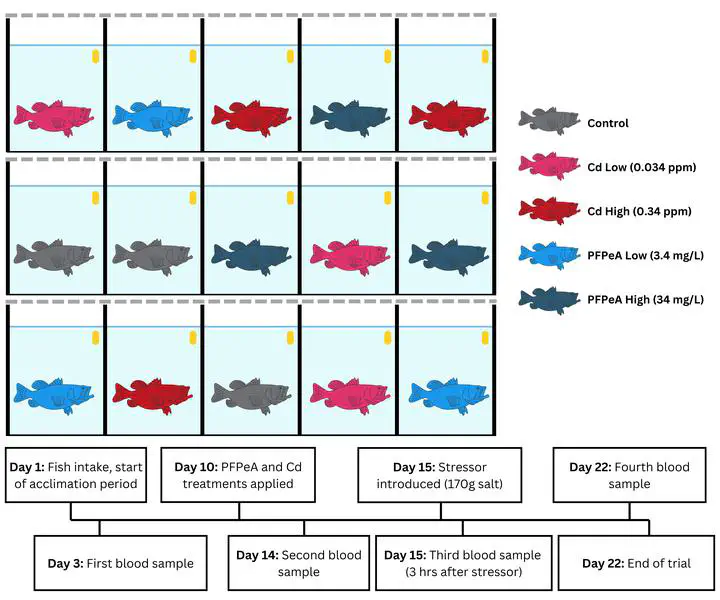
Understanding how contaminants influence physiological stress is vital for conserving aquatic organisms in increasingly altered environments. We examined whether exposure to cadmium (Cd) or perfluoropentanoic acid (PFPeA)—a short-chain per- and polyfluoroalkyl substance—altered neutrophil-to-lymphocyte ratios (NLRs) in largemouth bass (Micropterus nigricans) under controlled laboratory conditions. Using NLR as a leukocyte-based biomarker associated with physiological stress responses, we compared five groups (control, Cd low, Cd high, PFPeA low, PFPeA high) across four sampling periods (baseline, post-treatment, 3 h after an abrupt salinity increase and 7 days later). High PFPeA exposure elevated NLR values within 4 days of treatment relative to the other groups. Following salinity exposure, all groups exhibited acute increases in NLR; however, elevated NLR persisted only in the high-PFPeA group 1 week later. Neither Cd treatment nor low PFPeA exposure altered NLR relative to controls. Our findings suggest that high PFPeA exposure may alter leukocyte dynamics and influence the interpretation of leukocyte-based stress biomarkers in freshwater fishes exposed to additional environmental stressors. More broadly, xenobiotic contaminants may complicate the interpretation of physiological biomarkers used in conservation and management contexts.

Anthony Johnson
M.Sc. Graduate

Tyler Steven Coleman
Assistant Professor
My research interests lie at the interface between ecology (e.g., population, community, behavioral), biology (e.g., physiology, morphology, ontogeny), and natural resource management.
Jasmine Nasser
M.Sc. Graduate