Assessing oyster size distributions within intertidal Eastern Oyster (Gmelin, 1791) populations across restoration sites, harvest zones, and spatial locations in the Big Bend of Florida
(Crassostrea virginica)
Abstract
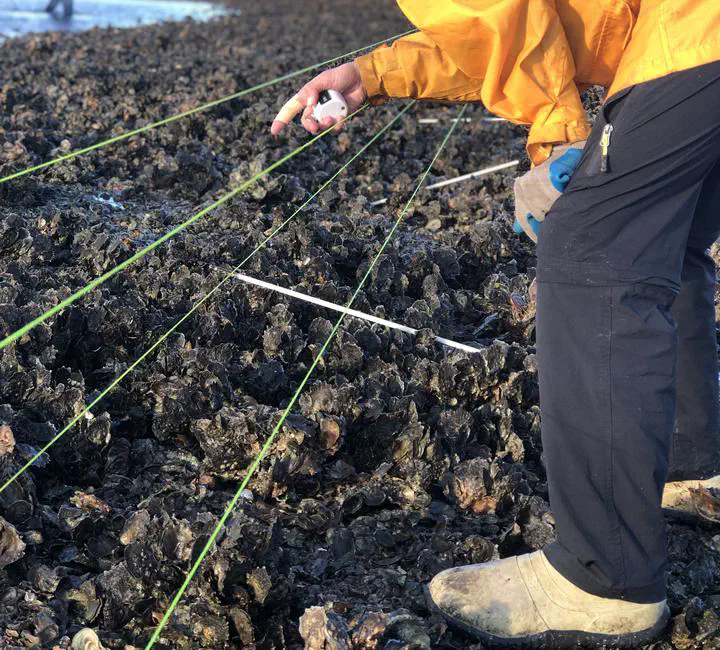
Eastern oyster Crassostrea virginica (Gmelin, 1791) shell height from more than 27,000 individuals were sampled over 12 y from control and restored intertidal oyster reefs in the Big Bend region of Florida to evaluate how spatial variation, harvest status, and restoration influence size structure. Analysis with Bayesian regression models (fixed and random effects) showed that spatial differences, especially across relic shoreline zones, were the primary determinants of oyster height. Inshore intertidal reefs supported the largest oysters (mean ≈ 37.1 mm), whereas offshore intertidal reefs supported the smallest (mean ≈ 25.0 mm). Harvest status had modest effects, typically shifting mean heights by less than 1 mm after accounting for spatial structure. In contrast, restoration produced strong, rapid responses in oyster heights. At Lone Cabbage (LC) Reef (offshore site), restoration increased mean oyster height in areas closed to harvest from 24.0 to 30.4 mm (about +6 mm) and to 33.5 mm (about +9 mm) in areas open to harvest. Restoration response was rapid, as within 2 y restored offshore reefs exhibited size structures approaching those of viable unrestored inshore reefs, indicating that intertidal restoration can succeed even where harvest occurs. These results highlight the key role of spatial setting and the roles of substrate and reef elevation in promoting intertidal oyster population size structure.

Tyler Steven Coleman
Assistant Research Professor
My research interests lie at the interface between ecology (e.g., population, community, behavioral), biology (e.g., physiology, morphology, ontogeny), and natural resource management.